🎉 Up to 70% Off Selected ItemsShop Sale

Designs for Health Premenatone
Traditional use and herbal context
Vitex agnus-castus (Chaste Tree) has a long history of use in Western herbal medicine for conditions of the female reproductive system. Its use for gynaecological purposes dates back to ancient Greek and Roman medicine, with references in the works of Hippocrates, Dioscorides, Pliny, and Theophrastus. Traditional texts describe Chaste Tree as a botanical used primarily for menstrual abnormalities, mastalgia, and to promote menstruation, with continued use through medieval and early modern European herbal traditions.
In Western herbal medicine, V. agnus-castus is traditionally used to support menstrual cycle regularity and to help relieve symptoms associated with premenstrual tension and menstruation. It is also traditionally used to relieve symptoms associated with menopause.
Botanical description and plant part used
V. agnus-castus is a deciduous shrub belonging to the family Lamiaceae (formerly Verbenaceae). The medicinal part is the dried, ripe fruit (berry), which has historically been used both as a medicinal agent and as a culinary spice substitute, giving rise to the common name “monk’s pepper”. The fruit remains the primary plant part employed in traditional and contemporary herbal preparations.
Phytochemistry and extract characterisation
Herbal preparations of V. agnus-castus are derived from the fruit and contain a complex mixture of volatile and non-volatile phytochemical constituents. The essential oil fraction of mature fruit typically contains approximately 0.4–0.7% (v/w), depending on extraction conditions, and is composed predominantly of monoterpenes and sesquiterpenes including bornyl acetate, 1,8-cineole, limonene, α- and β-pinene, β-caryophyllene, and α-terpinyl acetate.
In addition to volatile constituents, V. agnus-castus fruit contains diterpenoids, flavonoids, and iridoid glycosides. Reported labdane-type diterpenoids include rotundifuran and vitexilactone, while flavonoid constituents include casticin, orientin, and isovitexin. The iridoid glycosides agnuside and aucubin are also characteristic components of the fruit.
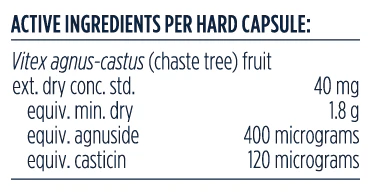
Due to the complexity of its phytochemical profile and the absence of a single identified active constituent, modern V. agnus-castus preparations are characterised using marker compounds for quality control. The iridoid glycoside agnuside and the flavonol casticin are commonly used as phytochemical markers to support extract characterisation and batch-to-batch consistency. Contemporary herbal standards emphasise qualitative and quantitative characterisation based on multiple constituent classes, including flavonoids, diterpenoids, and iridoid glycosides, rather than reliance on a single compound.
Mechanism of action
Available evidence suggests that the activity of V. agnus castus is mediated centrally via the hypothalamic–pituitary axis rather than through direct hormonal effects. Through modulation of prolactin and downstream hypothalamic pituitary–ovarian (HPO) signalling, V. agnus-castus is considered relevant to its traditional and contemporary use for supporting healthy female hormonal balance and relieving symptoms associated with premenstrual tension and menstrual irregularity.
Therapeutic use
Chaste Tree is classified in naturopathic and herbal texts as a key botanical for conditions associated with the HPO axis and the luteal phase of the menstrual cycle.
Traditional and contemporary herbal sources describe the herb as particularly relevant for symptoms associated with premenstrual tension, including breast tenderness, mood changes, irritability, and headache. Clinical and traditional use further support its application in women experiencing menstrual cycle disturbances. It is also traditionally used in Western herbal medicine to support menstrual cycle regularity and to help relieve dysmenorrhoea.
V. agnus-castus has also been traditionally used to relieve symptoms associated with menopause, particularly where symptoms overlap with premenstrual-type presentations.
Clinical considerations
V. agnus-castus acts via central neuroendocrine pathways and should be prescribed by a trained practitioner familiar with its actions and contraindications. Traditional prescribing guidance indicates that Vitex is best initiated in the early part of the menstrual cycle, preferably prior to ovulation, and administered as a single daily dose, commonly in the morning.
Dose individualisation is important, as both excessively high and insufficient doses may exacerbate symptoms in some individuals. Dosage should be adjusted according to the clinical presentation, associated symptoms, and the age and hormonal status of the patient. Traditional herbal use indicates that Chaste Tree should be assessed over multiple menstrual cycles rather than for acute symptom relief. A minimum trial period of 2–3 consecutive cycles is generally recommended to evaluate clinical response in premenstrual symptoms and menstrual cycle regularity. Continued use may be guided by practitioner assessment of symptom pattern, cycle response, and individual tolerability.
Directions to use:
Adults: Take 1 capsule per day or as directed by your healthcare practitioner.
Allergen Information:
- No Added: Gluten, Dairy, Seeds, Eggs, Yeast or Nuts
$24.58
Designs for Health Premenatone—
$24.58
Product Information
Product Information
Shipping & Returns
Shipping & Returns
Description
Traditional use and herbal context
Vitex agnus-castus (Chaste Tree) has a long history of use in Western herbal medicine for conditions of the female reproductive system. Its use for gynaecological purposes dates back to ancient Greek and Roman medicine, with references in the works of Hippocrates, Dioscorides, Pliny, and Theophrastus. Traditional texts describe Chaste Tree as a botanical used primarily for menstrual abnormalities, mastalgia, and to promote menstruation, with continued use through medieval and early modern European herbal traditions.
In Western herbal medicine, V. agnus-castus is traditionally used to support menstrual cycle regularity and to help relieve symptoms associated with premenstrual tension and menstruation. It is also traditionally used to relieve symptoms associated with menopause.
Botanical description and plant part used
V. agnus-castus is a deciduous shrub belonging to the family Lamiaceae (formerly Verbenaceae). The medicinal part is the dried, ripe fruit (berry), which has historically been used both as a medicinal agent and as a culinary spice substitute, giving rise to the common name “monk’s pepper”. The fruit remains the primary plant part employed in traditional and contemporary herbal preparations.
Phytochemistry and extract characterisation
Herbal preparations of V. agnus-castus are derived from the fruit and contain a complex mixture of volatile and non-volatile phytochemical constituents. The essential oil fraction of mature fruit typically contains approximately 0.4–0.7% (v/w), depending on extraction conditions, and is composed predominantly of monoterpenes and sesquiterpenes including bornyl acetate, 1,8-cineole, limonene, α- and β-pinene, β-caryophyllene, and α-terpinyl acetate.
In addition to volatile constituents, V. agnus-castus fruit contains diterpenoids, flavonoids, and iridoid glycosides. Reported labdane-type diterpenoids include rotundifuran and vitexilactone, while flavonoid constituents include casticin, orientin, and isovitexin. The iridoid glycosides agnuside and aucubin are also characteristic components of the fruit.
Due to the complexity of its phytochemical profile and the absence of a single identified active constituent, modern V. agnus-castus preparations are characterised using marker compounds for quality control. The iridoid glycoside agnuside and the flavonol casticin are commonly used as phytochemical markers to support extract characterisation and batch-to-batch consistency. Contemporary herbal standards emphasise qualitative and quantitative characterisation based on multiple constituent classes, including flavonoids, diterpenoids, and iridoid glycosides, rather than reliance on a single compound.
Mechanism of action
Available evidence suggests that the activity of V. agnus castus is mediated centrally via the hypothalamic–pituitary axis rather than through direct hormonal effects. Through modulation of prolactin and downstream hypothalamic pituitary–ovarian (HPO) signalling, V. agnus-castus is considered relevant to its traditional and contemporary use for supporting healthy female hormonal balance and relieving symptoms associated with premenstrual tension and menstrual irregularity.
Therapeutic use
Chaste Tree is classified in naturopathic and herbal texts as a key botanical for conditions associated with the HPO axis and the luteal phase of the menstrual cycle.
Traditional and contemporary herbal sources describe the herb as particularly relevant for symptoms associated with premenstrual tension, including breast tenderness, mood changes, irritability, and headache. Clinical and traditional use further support its application in women experiencing menstrual cycle disturbances. It is also traditionally used in Western herbal medicine to support menstrual cycle regularity and to help relieve dysmenorrhoea.
V. agnus-castus has also been traditionally used to relieve symptoms associated with menopause, particularly where symptoms overlap with premenstrual-type presentations.
Clinical considerations
V. agnus-castus acts via central neuroendocrine pathways and should be prescribed by a trained practitioner familiar with its actions and contraindications. Traditional prescribing guidance indicates that Vitex is best initiated in the early part of the menstrual cycle, preferably prior to ovulation, and administered as a single daily dose, commonly in the morning.
Dose individualisation is important, as both excessively high and insufficient doses may exacerbate symptoms in some individuals. Dosage should be adjusted according to the clinical presentation, associated symptoms, and the age and hormonal status of the patient. Traditional herbal use indicates that Chaste Tree should be assessed over multiple menstrual cycles rather than for acute symptom relief. A minimum trial period of 2–3 consecutive cycles is generally recommended to evaluate clinical response in premenstrual symptoms and menstrual cycle regularity. Continued use may be guided by practitioner assessment of symptom pattern, cycle response, and individual tolerability.
Directions to use:
Adults: Take 1 capsule per day or as directed by your healthcare practitioner.
Allergen Information:
- No Added: Gluten, Dairy, Seeds, Eggs, Yeast or Nuts