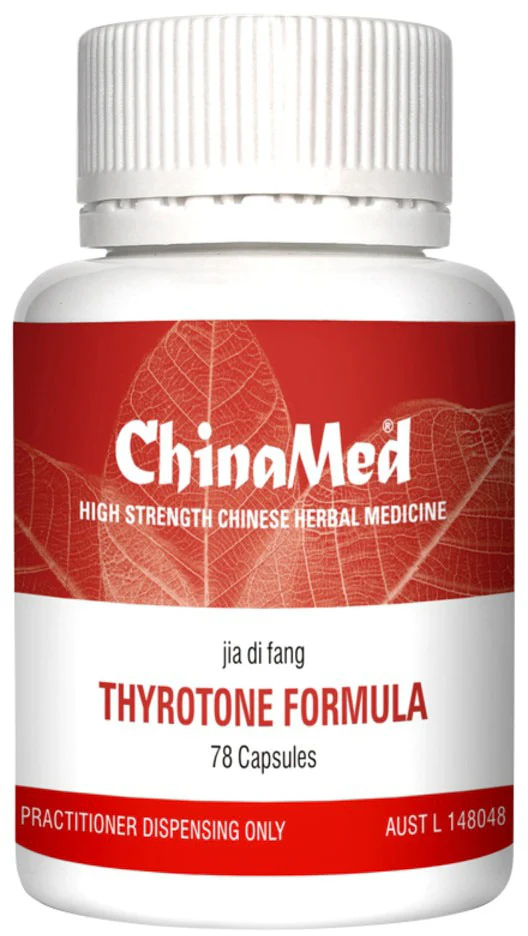
ChinaMed Thyrotone Formula 78 Capsules
Traditional Chinese medicine did not recognise the thyroid gland as a separate and distinctive organ up until quite recently. In line with it's capacity for growth, development and inclusion of a broad range of theories from diverse paradigms, TCM as practiced in contemporary China has developed elaborate protocols for the diferential diagnosis and treatment of various disorders of the thyroid gland. This formula is an example of how an herbal physician practicing in modern China would approach the treatment of a patient with an underactive thyroid gland.
The theory is that the functions of the thyroid gland are included within the activities of the Kidney, Spleen and Liver. In hypothyroidism, the key signs and symptoms are:
- Cold intolerance
- Constipation
- Edema
- Dry and flaking skin, hair loss
- Irregular menstruation
These can be understood to derive from a deficiency of the Yang Qi, with failure of its driving, warming, defending, containing and transforming functions. Thus Spleen and Kidney Yang deficiency are the major underlying pathodynamics of this condition.
It should be noted that subclinical deficiency of the thyroid gland is quite common, especially in women over 60 years (just under 20%). A significant increase in incidence begins in women after the age of 35 and a high percentage of these patients (50-80%) will eventually develop clinical hypothyroidism, requiring treatment with thyroxine.
In China herbal therapy gives satisfactory clinical outcomes, even in cases with overt hypothyroidism, such as Hashimoto's thyroiditis and other forms of primary hypothyroidism. Generally treatment should continue for the long term, i.e. 12 months or more.
TCM ACTIONS
Tonifies the Qi and strengthens the Spleen, warm-tonifies the Kidney, nourishes the Blood.
TCM SYNDROMES
Spleen-Kidney Yang deficiency.
INDICATIONS
Hypothyroidism, subclinical hypothyroidism.
SIGNS & SYMPTOMS
(Key clinical features in bold)
-
Fatigue, muscular weakness
-
Pallor
-
Cold intolerance, low basal body temperature
-
Constipation
-
Dry and flaking skin, hair loss
- Irregular menstruation
- Depressed mood, emotional lability
- Forgetfulness, impaired memory, inability to concentrate
- Hearing loss
- Edema
-
Pale tongue that may also be swollen, with a white and moist or slippery coat
- Deep, weak and slow pulse
Product Information
Product Information
Shipping & Returns
Shipping & Returns
Description
Traditional Chinese medicine did not recognise the thyroid gland as a separate and distinctive organ up until quite recently. In line with it's capacity for growth, development and inclusion of a broad range of theories from diverse paradigms, TCM as practiced in contemporary China has developed elaborate protocols for the diferential diagnosis and treatment of various disorders of the thyroid gland. This formula is an example of how an herbal physician practicing in modern China would approach the treatment of a patient with an underactive thyroid gland.
The theory is that the functions of the thyroid gland are included within the activities of the Kidney, Spleen and Liver. In hypothyroidism, the key signs and symptoms are:
- Cold intolerance
- Constipation
- Edema
- Dry and flaking skin, hair loss
- Irregular menstruation
These can be understood to derive from a deficiency of the Yang Qi, with failure of its driving, warming, defending, containing and transforming functions. Thus Spleen and Kidney Yang deficiency are the major underlying pathodynamics of this condition.
It should be noted that subclinical deficiency of the thyroid gland is quite common, especially in women over 60 years (just under 20%). A significant increase in incidence begins in women after the age of 35 and a high percentage of these patients (50-80%) will eventually develop clinical hypothyroidism, requiring treatment with thyroxine.
In China herbal therapy gives satisfactory clinical outcomes, even in cases with overt hypothyroidism, such as Hashimoto's thyroiditis and other forms of primary hypothyroidism. Generally treatment should continue for the long term, i.e. 12 months or more.
TCM ACTIONS
Tonifies the Qi and strengthens the Spleen, warm-tonifies the Kidney, nourishes the Blood.
TCM SYNDROMES
Spleen-Kidney Yang deficiency.
INDICATIONS
Hypothyroidism, subclinical hypothyroidism.
SIGNS & SYMPTOMS
(Key clinical features in bold)
-
Fatigue, muscular weakness
-
Pallor
-
Cold intolerance, low basal body temperature
-
Constipation
-
Dry and flaking skin, hair loss
- Irregular menstruation
- Depressed mood, emotional lability
- Forgetfulness, impaired memory, inability to concentrate
- Hearing loss
- Edema
-
Pale tongue that may also be swollen, with a white and moist or slippery coat
- Deep, weak and slow pulse